
How Lakewood's hail season affects your roof's lifespan
Lakewood roofs do not wear out on a calendar. They wear out storm by storm, and hail season — mid-April to September, peaking May to July — is when most of that wear happens.
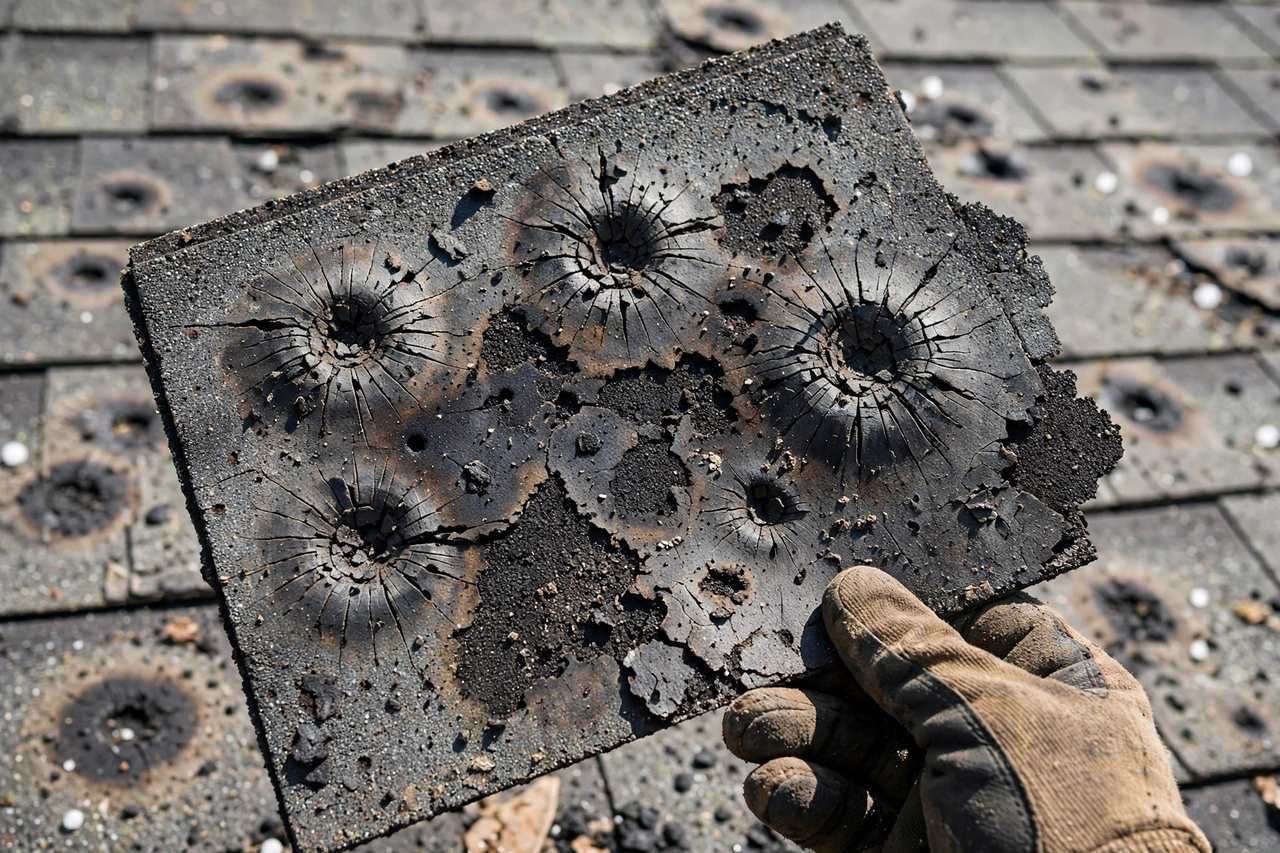
A Lakewood roof lives in one of the most hail-exposed metros in the country, and the damage is cumulative. One storm bruises a few shingles. The next one finds the bruises. Over a decade of hail seasons, that slow accumulation is what decides whether a roof reaches the end of its service life or gets replaced early. This guide explains how much life hail actually costs, which sizes do the damage, how different materials hold up, and what you can realistically do about it.
How much roof life does one Lakewood hail season actually cost?
There is no fixed number of years per storm, and anyone selling one is guessing. What the research does support is the shape of the problem: roofing research used for Lakewood puts the working figure for Front Range asphalt shingle life at roughly 13 to 17 years — well short of the 20-plus years the same shingle might deliver in a mild climate. Hail is the main reason. Each impact crushes the shingle mat and strips granules, and the bruised spot dries, cracks, and lets water in over the following months. A roof that has been through several damaging seasons is, functionally, an older roof than its install date suggests.
The practical consequence is timing. In Lakewood, the question is rarely “is the roof old enough to replace?” It is “how many damaging seasons has it already absorbed?” A 12-year-old roof that has taken two or three real hail hits may be closer to replacement than a 15-year-old roof that has been lucky. That is why an inspection after a storm matters even when nothing is leaking yet — see our roof inspection page for what a post-storm check covers.
How often does it hail in Lakewood, Colorado?
Hail season in Lakewood runs from mid-April to September, with the peak in May through July. That window is the shared baseline in the research, drawn from NOAA and National Weather Service records for the Front Range. Damaging storms can arrive into September, but the heaviest concentration is late spring and early summer, when warm, moist air pushes against the foothills and builds the supercells that drop large hail.
The defining Lakewood event is still the 8 May 2017 supercell. It formed over Evergreen in the early afternoon and tracked east through Golden, Lakewood, Wheat Ridge, and Arvada. NOAA’s place-name record for Lakewood in 2015–2024 lists the largest Lakewood hail from that storm at 2.00 inches; the county maximum that day was 2.75 inches at Edgewater, which is a separate city and should not be quoted as a Lakewood fall. Metro-wide insured losses reached $2.3 billion, and Colorado Mills Mall in Lakewood was closed until November 2017 after its skylights shattered. The National Weather Service in Boulder names Lakewood among the hardest-hit communities that day. Any other storm is a different place and a different event, not a Lakewood one.
What hail size actually damages a roof?
Size is the deciding factor, and the threshold is lower than most homeowners expect. Pea-sized hail is mostly cosmetic. Once stones reach about 1 inch — roughly quarter-sized — they can bruise an asphalt shingle mat. At 1.5 inches and above, fractures, split tabs, and dented vents and gutters are common. The 8 May 2017 storm dropped baseball-size hail, up to 2.75 inches in the county at Edgewater (Lakewood’s largest that day was 2.00 inches), which is well past the point where any standard shingle survives unscathed.
The soft-metal test is the fastest way to read a storm from the ground. Walk the property and check gutters, downspouts, vents, and flashing. Dents there mean the hail was large enough to bruise shingles on the same slope. Our guide to spotting hail damage after a Lakewood storm walks through the full check.
How hail damage shortens roof lifespan, by material
Architectural asphalt shingles. The most common Lakewood roof, and the most hail-sensitive. Bruises and fractures shorten service life directly, because each bruise is a spot where the mat has been crushed and the granule layer is failing. On a 1970s-deck home — the median Lakewood home was built in 1977 — hail damage often arrives on a roof that is already on its second or third cycle, so the margin is thin.
Class 4 impact-resistant shingles. Tested to UL 2218, which drops a 2-inch steel ball from 20 feet and checks for cracking, splitting, or fracturing. Class 4 is the hail upgrade worth discussing at re-roof time: it costs more than standard architectural shingles, and some carriers offer a premium reduction for it — but that reduction varies by carrier and policy and is never automatic, so ask your carrier rather than assuming a payback. And Class 4 is not hail-proof: 2.75-inch hail like the county maximum in the May 2017 storm (recorded at Edgewater, not in Lakewood) can still damage Class 4 shingles, flashing, vents, and gutters.
Standing-seam metal. Inherently impact-resistant and long-lived, with service-life claims commonly cited at 40 to 50 years, but hail dents steel cosmetically even when it is functionally intact — and whether a carrier pays for cosmetic dents depends on the policy’s cosmetic-damage exclusion. See our metal vs shingle comparison for the full trade-off, and our metal roof installation page.
Low-slope membranes. TPO and EPDM on flat and low-slope roofs puncture rather than bruise, and ponding water after a storm hides the damage. If your building has a low-slope roof, read our flat roof repair page.
How to protect your roof from hail in Lakewood CO
You cannot hail-proof a roof in Lakewood, but you can change the odds at re-roof time. The single most effective step is choosing Class 4 impact-resistant shingles when the roof is replaced — that is when the upgrade costs least, because the tear-off, decking, and labor are already being paid for. The second is keeping the roof’s weak points sound: flashing, pipe boots, and ridge caps fail first under hail and wind, and a roof maintenance visit before hail season catches the ones that are already loose.
The third is documentation. Photograph the roof and the soft metal around the house each spring, before hail season. If a storm hits, those photos are the “before” your adjuster needs, and they are the difference between a claim that is easy to prove and one that turns into an argument about whether the dents are new.
What to watch out for after a storm
- Dents on soft metal. Gutters, vents, and flashing dent before shingles show damage. Two or more dented surfaces mean the storm was big enough to matter.
- Granules in the gutters. A heavy granule deposit after a storm means the shingle surface took hits, even if the roof looks fine from the street.
- Dark or soft spots on shingles. Bruises are often felt rather than seen. If you can safely reach an eave from a ladder, press gently: a bruise gives under your thumb.
- Out-of-town crews knocking on doors. After every major hail event, crews from outside the area canvass Lakewood neighborhoods. A Lakewood roofer with a verifiable local address is the safer call — see our guide on what to check before hiring a roofer.
- Waiting for a leak. Hail damage rarely leaks immediately. By the time a ceiling stain appears, the bruised shingles have been failing for months.
When to call a professional
Call for an inspection after any storm that drops hail of about 1 inch or larger, or any storm that dents your gutters or vents. The inspection is the only way to know whether the roof took functional damage or just cosmetic hits, and the photos from that inspection are what a claim is built on. If you are weighing a re-roof, the same visit is the right time to talk through Class 4 shingles and the roof replacement scope under Lakewood’s 2021 code — tear-off to deck, one layer only, Class A covering citywide, and a permit before tear-off.
Roof Authority LLC inspects residential roofs across Lakewood, including Green Mountain and Kendrick Lake. Call (720) 817-3348 to book a post-storm inspection.
Frequently Asked Questions
How long does a roof last in Lakewood, Colorado?
Roofing research used for Lakewood puts the working figure for Front Range asphalt shingle life at roughly 13 to 17 years, with hail the main reason it falls short of milder climates. Class 4 impact-resistant shingles and standing-seam metal last longer, but no roof in Lakewood is hail-proof.
When is hail season in Lakewood?
Hail season runs from mid-April to September, with the peak in May through July, according to NOAA and National Weather Service records for the Front Range. Damaging storms can arrive into September.
What was the worst hailstorm in Lakewood?
The 8 May 2017 supercell is the defining Lakewood hail event: baseball-size hail, $2.3 billion in metro-wide insured losses, and Colorado Mills Mall closed until November 2017. NOAA records the largest Lakewood hail that day at 2.00 inches.
Are Class 4 shingles worth it in Lakewood?
Class 4 shingles tested to UL 2218 resist functional hail damage better than standard architectural shingles, and some carriers offer a premium reduction for them, but the reduction varies by carrier and is never automatic. Class 4 is not hail-proof: 2.75-inch hail — the county maximum that day, recorded at Edgewater — can still damage it.
Should I get my roof inspected after every hailstorm?
After any storm that drops hail of about 1 inch or larger, or dents gutters and vents, yes. Hail damage often shows no leak for months, and an inspection with photos is what a later insurance claim is built on.
Get help with Roofing in Lakewood
If hail has been through your neighborhood, the lowest-cost certainty is an inspection. Call (720) 817-3348 and we will check the roof, document what the storm did, and tell you plainly whether it needs repair, replacement, or nothing at all.
Roof Authority LLC is based at 200 Union Blvd, Lakewood, CO 80228, and works Monday to Saturday, 7:00 AM to 5:00 PM. Phone is the way to reach us.