
Roof Leak Repair
Roof Leak Repair in Lakewood, CO
A ceiling stain means water is already inside — and the stain is rarely above the leak. Water gets in at a flashing joint, a cracked boot, or a valley without membrane, then runs along the deck or a rafter and shows up rooms away. Roof leak repair in Lakewood, CO is tracing that path back to the entry point and fixing the cause there. If water is coming in now, call (720) 817-3348, Monday to Saturday 7:00 AM to 5:00 PM.
Service overview
How a leak gets found and fixed
A leak repair is two jobs, and the second is useless without the first. First, find where the water gets in: walk the roof, look at the deck from the attic side, and trace the water path from the stain back to where it entered. Second, fix that entry point properly — rebuild the flashing, swap the boot, rework the valley. Sealant smeared over a failed joint lasts a season at best, and we do not sell it as a repair.
The usual entry points in Lakewood are the same ones every inspection keeps finding: flashing at chimneys and valleys, pipe boots cracked by high-altitude UV, and valleys laid without membrane. Freeze-thaw makes it worse, because water works into a seam, freezes, and pries it open a little more each winter. A small leak on a roof with life left is a repair; a soft deck across a slope is a different answer, and ourrepair or replace guide explains how that call gets made.
Practical benefits
What a proper leak repair gives you
A leak is a small problem with a short fuse. Fixed at the source, it stays small.
The entry point, not the stain
Water is traced from the stain back to where it got in, which is often a different place entirely. Fixing the stain without fixing the entry point just moves the next leak.
Flashing taken apart and rebuilt
Failed flashing comes out and gets rebuilt, with a cricket on the high side of any chimney or penetration wider than 30 inches. That is code work, and it is what keeps the next storm out.
A deck that gets checked, not covered
A leak means water has been reaching the deck for a while. The sheathing under the leak is checked for rot before anything is closed up, because a repair over a rotten deck is a repair that fails.
A photo record for the next storm
Every leak we trace gets photographed at the entry point and after the fix, so the next inspection starts from a known record. If hail hits later, the adjuster can tell what was repaired and what the storm did.
How service works
How a leak repair runs
Five steps, from the stain on the ceiling to a repair you can check after the next rain.
STEP 01
Trace the leak
We walk the roof and look from the attic side, following the water path from the stain back to the entry point. You get photos of what we find and a written scope for the fix before any work starts.
Tools and methods
Tools and methods we use on leak repairs
Moisture meter for tracing water
The meter reads the deck and attic framing for damp the eye cannot see, so the diagnosis does not stop at the stain.
Pry bar for opening the suspect course
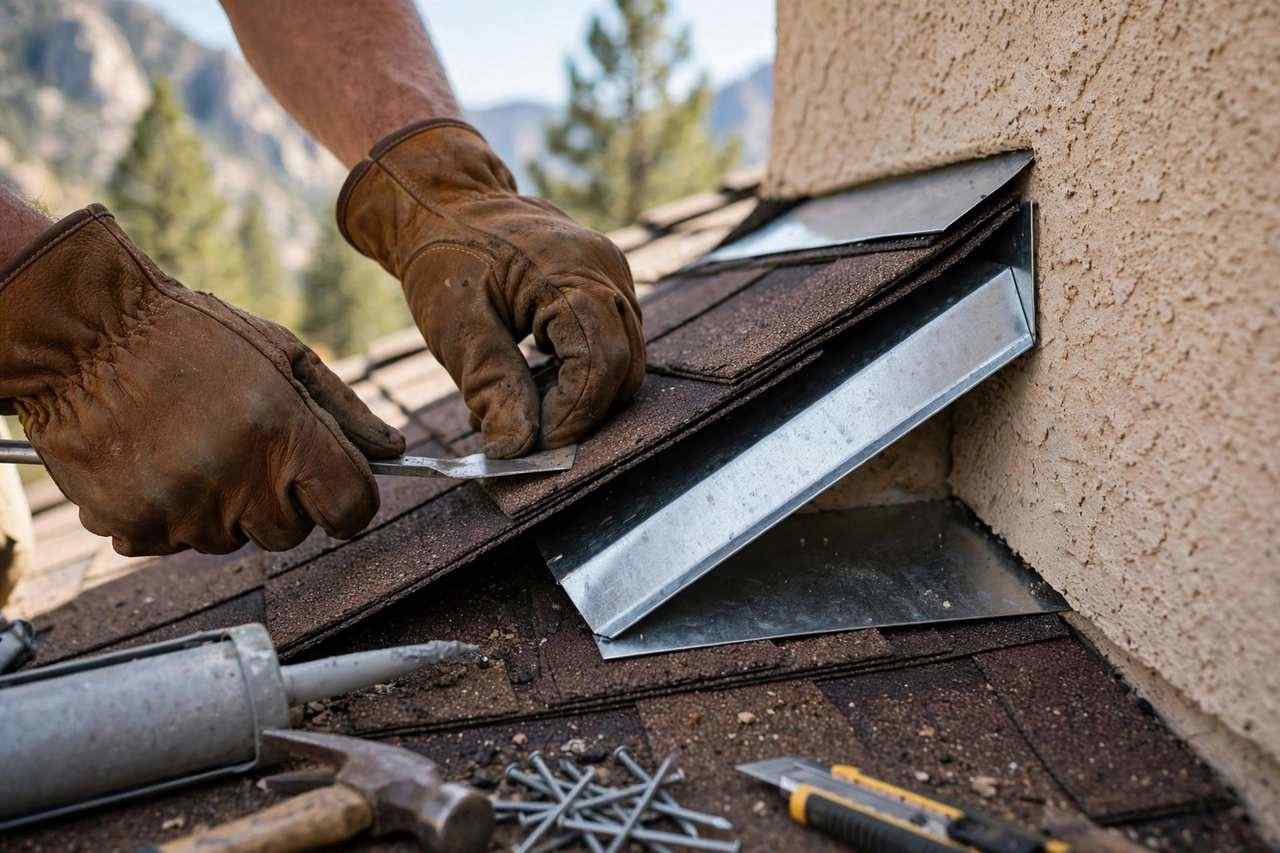
The suspect course comes up with a pry bar, and the flashing with it, without tearing the sound shingles around them — the patch has to seat into solid material, not into a ragged edge.
Hook blade and utility knife
The repair edge is cut clean with a hook blade, so the new shingles seat tight against the old courses and water cannot work under the seam.
Sealant gun, detail work only
Sealant goes on flashing details and pipe boots in the right bead. It is a detail material for the finished repair, never a substitute for rebuilt flashing.
Nail gun for the repair courses
The new shingles are nailed to the right depth and pattern so they hold in wind, on patches big enough to warrant the gun.
Chalk line
Courses are lined up with the existing roof so the patch sheds water instead of catching it.
Tape measure and the 100-square-foot line
The wet area is measured in square feet, because at 100 square feet or more the job needs a City permit before work starts.
Camera and photo record
The entry point and the fix are photographed before, during, and after, so you can see what was wrong and what changed without climbing a ladder.
Magnet sweeper
Nails come off the yard and driveway after the work, because a small job deserves the same cleanup as a full roof.
Leaf blower
Granules and debris are blown out of the repair area and the gutters, so the finished patch is clean and water drains.
Where this service fits
When a leak repair is the right call
A stain appeared after the last storm
Water found a way in during wind-driven rain, and the entry point is usually a flashing joint or a valley. A repair at the source stops the next storm from using the same path. Ourguide to ceiling leaks after a storm explains what to look for inside.
A boot cracked in the sun is letting water in
High-altitude UV dries out rubber boots, and a cracked boot leaks a little at first and a lot later. Swapping the boot is a small job that keeps the deck from rotting quietly underneath.
Flashing failed at the chimney
Freeze-thaw works flashing loose, and water gets behind it and shows up as a ceiling stain in January. The fix is a rebuilt flashing detail with a cricket on the wide side, not sealant smeared over the old joint.
One bad valley on an otherwise sound roof
A roof with years left in it should not come off for one bad valley or one cracked boot. The repair buys those years back, and the inspection says how many there are.
Local execution
Leak repairs across Lakewood neighbourhoods
Leaks follow the house. Wartime bungalows, 1970s ranches and townhomes each leak in different places, and the permit office can change with the parcel. Here is where leak repairs usually start, area by area.
A leak’s source changes with the house, and Lakewood’s houses change by neighbourhood. See our locations page.
Problems we solve
Leak problems we fix most often
A leak is never just a stain. It is water reaching wood, and wood does not wait. These are the four entry points we fix most.
Chimney flashing leaks
Freeze-thaw works flashing loose, water gets behind it, and the stain shows up in January. The fix is a rebuilt flashing detail with a cricket on the wide side, so water sheds instead of pooling.
Pipe boots cracked by UV
UV at 5,500 feet dries out rubber boots. A cracked boot leaks a little at first, then a lot, and the deck under it rots quietly. Swapping the boot is a small job; swapping the deck is not.
Valleys leaking first in a storm
Valleys carry the most water on the roof, so a valley without membrane, or with worn shingles, is the first to leak in a storm. The fix is a rebuilt valley detail with membrane under it.
Ice dam leaks at the eaves
Heat loss melts snow on the heated part of the roof and it refreezes at the cold eave, backing water under the shingles. Membrane at the eaves and balanced ventilation are the practical answer.
Need help?(720) 817-3348
A practical standard for every visit.
Clear planningPrepared arrivalsCareful workLocal follow-through
Experience in the details
A Lakewood roofer you can check
A leak is a diagnosis first and a repair second — the roofer you call should be one you can check, and ours is on the About page.
Where we work
One local team. A lot of ground covered.
Notes from local customers
What Lakewood Homeowners Say
We had several roofing contractors inspect our roof after a recent hail storm. Keith was the most professional and knowledgeable of them all. He worked well with our insurance company, was there for the insurance adjuster's visit to our home, and his friendly crew replaced our roof in one day! They did a thorough cleanup afterward. Keith also noticed a hail damaged gutter that needed replacing and took care of that also. He also replaced four hail damaged window screens at no charge. We would highly recommend Roof Authority LLC to anybody needing a hail damaged roof repaired or replaced!
Great company to work with. would definitely recommend
A ceiling stain means water is already inside, and the entry point is often not above the stain — water runs along the deck and rafters before it shows inside. We walk the roof and look from the attic side, tracing the water path back to where it got in. The usual entry points are flashing at chimneys and valleys, cracked pipe boots, and worn valleys. We photograph what we find and show you before any work starts.
The honest number depends on the entry point and the deck underneath, which is why we inspect before pricing. A small leak patch runs lower than decking work, and the scope we write after the inspection names the number for your roof.
Slowing the water with a temporary patch is possible, but it is not a repair — and climbing a wet or steep roof is how people get hurt. Our guide to temporarily patching a roof leak explains what can be done safely from inside the attic, and when to stay off the roof entirely and call us at (720) 817-3348.
A repair that finds the true entry point, rebuilds the flashing, and puts membrane where it belongs will last. One that only covers the stain will not. Where the roof is near the end of its service life, or the deck is soft across a slope, we say so and price a replacement instead of selling a patch that will not hold.
Keep exploring
Related Services
Your next step is waiting
Stop the leak at its source
A stain means water is already inside, so the tracing starts now. Call (720) 817-3348, Monday to Saturday 7:00 AM to 5:00 PM, and we will find the entry point, show you the photos, and fix the cause, not the stain.
Start with the basics
Contact Roof Authority LLC
Water coming through the ceiling, or a stain that grows with every storm? Call Roof Authority LLC at (720) 817-3348. We are at 200 Union Blvd, Lakewood, CO 80228, and we answer the phone Monday to Saturday, 7:00 AM to 5:00 PM. Sunday we are closed.