
How often should you schedule a roof inspection in Lakewood
Once a year, plus once after any major hail or wind event. That is the schedule that fits Lakewood’s hail season, its snow, and its 1970s housing stock.
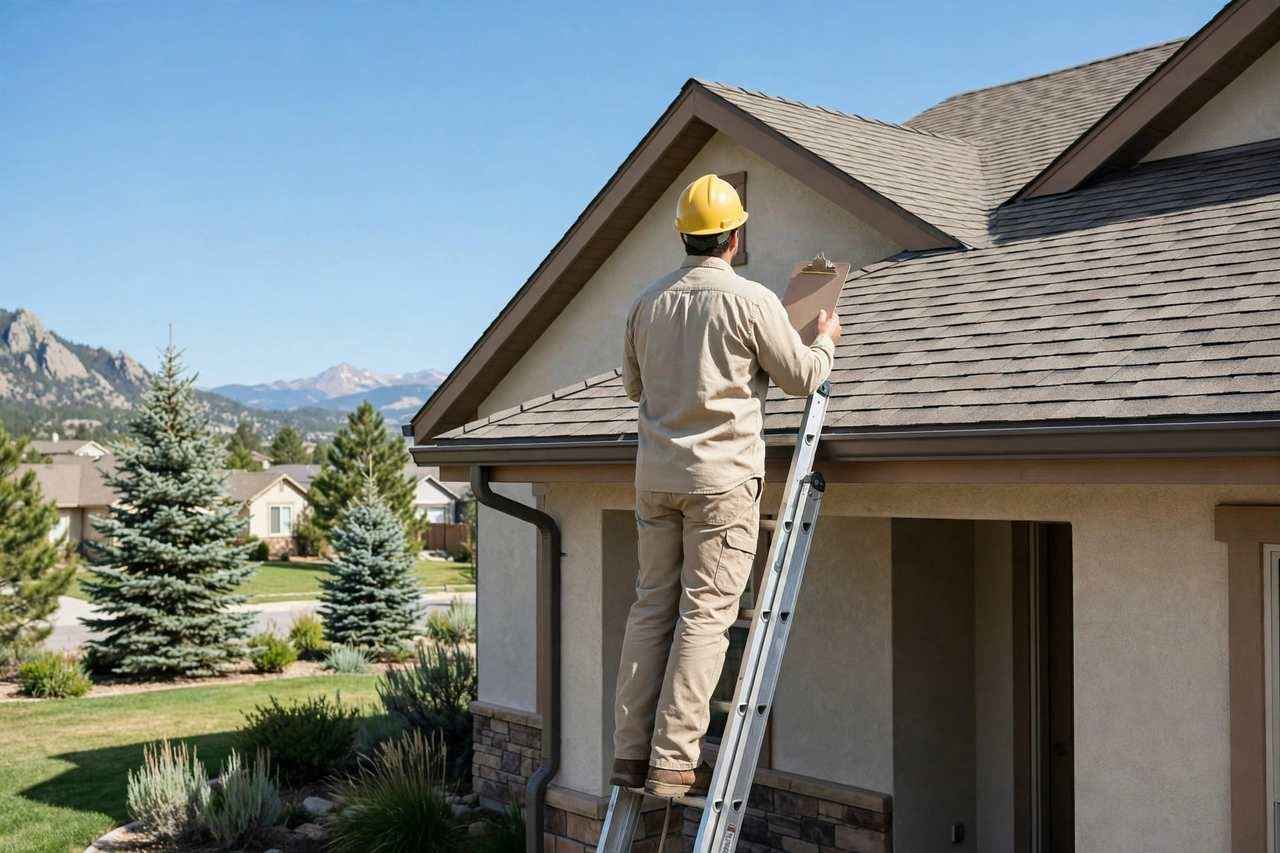
A roof inspection is not a formality in Lakewood. It is the only way to catch hail bruises before they become leaks, to find the flashing that worked loose over winter, and to know whether a roof that looks fine from the street is actually near the end of its service life. This guide sets out the schedule that fits Lakewood, what a real inspection covers, and what it costs.
The short answer for Lakewood homeowners
Book a roof inspection once a year, and add one after any storm that drops hail of about 1 inch or larger, or any wind event that lifts shingles or drops branches on the roof. For most Lakewood homes, the annual inspection belongs in the spring — after hail season’s early storms and before the summer peak — or in the fall, before winter. If you can only do one, do the spring one: it catches winter damage and sets a baseline before the storms that do the most harm.
Homes on the Green Mountain slopes and the park edge, where wind exposure is higher, and homes with low-slope sections, should not stretch the interval. The same goes for any roof that has already been through the 8 May 2017 storm or a later damaging event without an inspection since.
Why Lakewood roofs need a different schedule
Lakewood’s roofs age differently from roofs in milder markets, and the schedule has to reflect that. Hail season runs mid-April to September, peaking May to July. Snow loads to the City’s 30 psf design ground snow load. Freeze-thaw cycles work on flashing and sealant all winter. And the housing stock is old: the median Lakewood home was built in 1977, 1960–79 construction is 40.2% of the city’s housing, and the typical re-roof today is the second or third roof on a 1970s deck (U.S. Census Bureau, American Community Survey 2024 5-year). A roof on a 1970s deck, with prior overlays now barred by code and ventilation that predates modern practice, has less margin than a new roof — and a missed year of inspections costs more.
The other local factor is the code. Lakewood works under the 2021 IBC and IRC, with tear-off to deck, one layer only, and Class A covering citywide. A permit is required before tear-off on any re-roof or repair of 100 square feet or more, and the City closes out jobs with photo inspections through eTRAKiT. An inspector who knows that process will flag the things the City will flag — decking, flashing, and ventilation — before they become a failed inspection.
How often should you schedule a roof inspection in Lakewood CO?
Use this as the baseline, then adjust for your roof’s age and history:
- Every year: one full inspection, spring or fall, for every Lakewood home.
- After every major storm: hail of about 1 inch or larger, wind that lifts shingles, or a tree strike. See our guides to spotting hail damage and wind-lifted shingles.
- Twice a year: roofs over 15 years old, roofs with a prior hail claim, low-slope sections, and homes on exposed slopes such as Green Mountain.
- Before buying or selling: a roof inspection is the least expensive way to avoid a surprise at closing, especially on a 1960s or 1970s home.
- Before winter: a fall check catches the flashing and gutter problems that become ice dams and ceiling leaks in January.
What does a roof inspection include in Lakewood?
A proper inspection covers the whole roof system, not just the shingles. On the roof, the inspector checks shingle condition and bruising, ridge caps and hips, flashing at chimneys, valleys, and walls, pipe boots and vents, and the condition of the decking where it is visible. From the ground and the attic, they check gutters and downspouts for granule loss and dents, the attic for daylight, moisture, and ventilation, and the interior ceilings for stains that point to a leak path.
What you should get at the end is a written assessment with photos: what was found, where it is, whether it is repair or replacement scope, and what should be watched at the next inspection. If an inspection ends with a verbal “looks fine” and no photos, it was not an inspection. Ask what the inspection covers and what it costs before you book — and if the inspector finds damage, the written scope is what your adjuster will work from. See our roof inspection page for the service itself.
How much does a roof inspection cost in Lakewood CO?
Inspection pricing varies by roof size, pitch, and access, and Roof Authority LLC does not publish a price for it. What is published is the cost of what inspections find: most Lakewood roof repairs fall in the Denver-metro market range of $287–$980 (Angi Denver, August 2026), and a full re-roof runs roughly $9,000–$18,000 for a typical home. The inspection is what tells you which of those two numbers you are looking at. For the full breakdown, see our Lakewood roof replacement cost guide.
The expensive version of an inspection is the one that never happens. A bruised shingle found in May is a repair. The same bruise found in November, after a summer of rain and a winter of freeze-thaw, is often a decking replacement.
Seasonal timing: when to book your inspection
Spring (April–May): the best single slot. It catches winter damage, sets a photo baseline before hail season, and leaves time to act before the May–July peak.
After any storm (May–September): hail season. Inspect after any storm that dents soft metal or drops hail of about 1 inch or larger.
Fall (October): the pre-winter check. Gutters, flashing, and ventilation get one last look before snow and ice dams. See our guide to preparing your roof for winter.
Winter: inspections still happen, but snow cover hides shingle condition and ice makes the roof unsafe to walk. A winter inspection is mostly an attic and interior check, with the full roof inspection waiting for the thaw.
What to watch out for
- No photos, no report. A verbal opinion is not an inspection record, and it is useless to an adjuster.
- An inspection that is really a sales visit. If the “inspector” will only look at the roof after you sign something, walk away.
- Out-of-town crews after a storm. They canvass Lakewood after every hail event. A roofer with a verifiable Lakewood address — ours is 200 Union Blvd — is the safer call.
- Ignoring the attic. Ventilation and moisture problems show up in the attic first. An inspection that never looks inside is incomplete.
- Skipping the gutters. Granule loss and dents in the gutters are the earliest evidence of hail damage.
When to call a professional
Call for an inspection if it has been more than a year since the last one, if a storm has been through your neighborhood, if you see granules in the gutters or a stain on a ceiling, or if the roof is over 15 years old and has never been inspected. Any one of those is enough.
Roof Authority LLC inspects residential roofs across Lakewood, including Applewood, Eiber, and Morse Park. Call (720) 817-3348 to book. We work Monday to Saturday, 7:00 AM to 5:00 PM.
Frequently Asked Questions
How often should I get my roof inspected in Lakewood?
Once a year, plus once after any major hail or wind event. Roofs over 15 years old, roofs with a prior hail claim, and homes on exposed slopes should be inspected twice a year.
What does a roof inspection include?
Shingle condition and hail bruising, ridge caps and hips, flashing at chimneys, valleys and walls, pipe boots and vents, gutters and downspouts, and an attic check for moisture and ventilation. You should receive a written assessment with photos.
When is the best time to inspect a roof in Lakewood?
Spring, in April or May, is the best single slot: it catches winter damage and sets a photo baseline before the May to July hail peak. A fall inspection before winter is the second-best slot.
Does a roof inspection cost money in Lakewood?
Pricing varies by roof size, pitch, and access, and Roof Authority LLC does not publish an inspection price. Ask what the inspection covers and what it costs before you book.
Can a roof inspection find hail damage that is not leaking yet?
Yes. Hail bruises and granule loss are visible to a trained inspector long before they become leaks, and the photos from an inspection are what an insurance claim is built on.
Get help with Roofing in Lakewood
If it has been a year since your last inspection, or a storm has been through since, call (720) 817-3348. We will inspect the roof, document what we find with photos, and give you a written assessment.
Roof Authority LLC is based at 200 Union Blvd, Lakewood, CO 80228, and works Monday to Saturday, 7:00 AM to 5:00 PM. Phone is the way to reach us.