
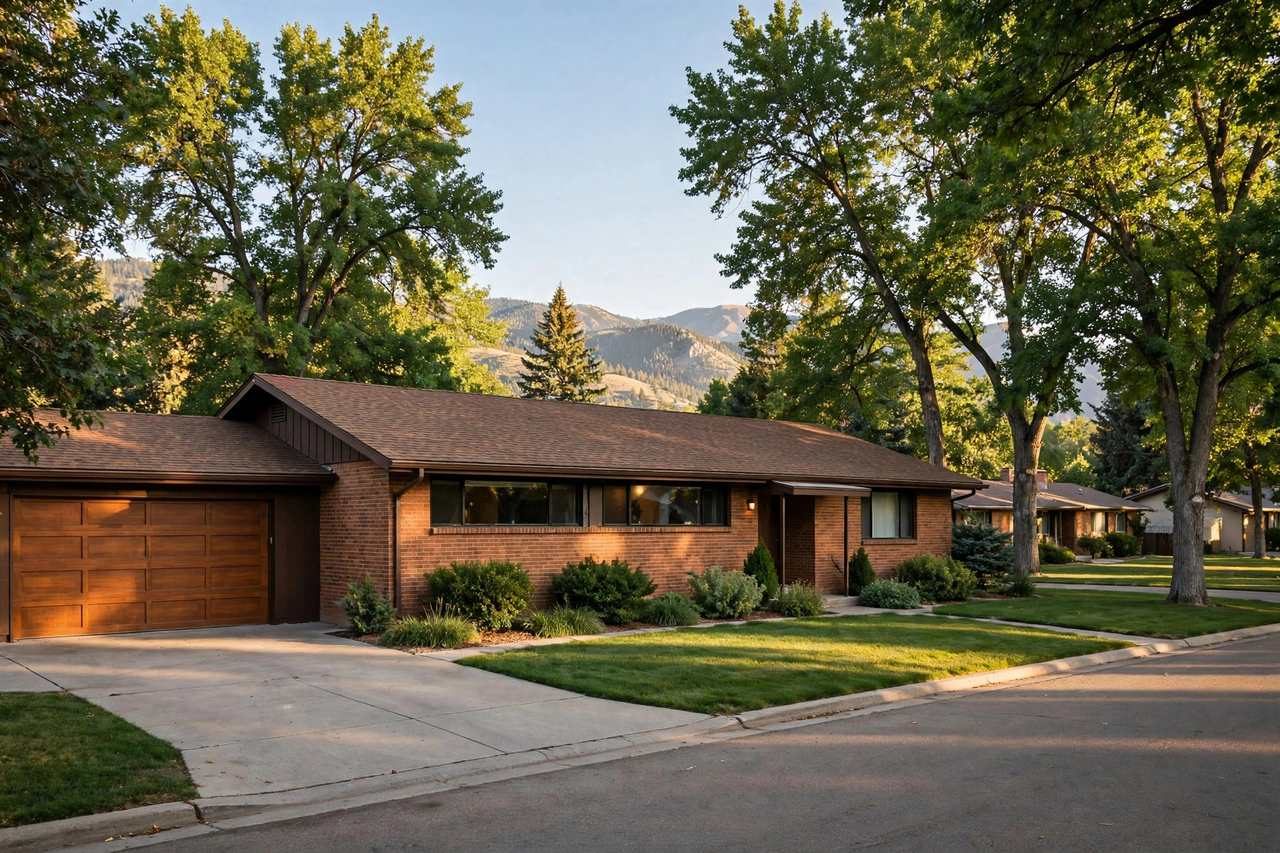
Residential Roofing
Residential Roofing in Lakewood, CO for Homes That Last
Roof Authority LLC works on residential roofs across Lakewood — single-family homes, townhomes, and multifamily buildings — in shingles, metal, and flat and low-slope systems. The median Lakewood home was built in 1977, so most of the roofs we see are second or third coverings on a 1970s deck, and 42% of occupied homes here are rentals, which means the person calling is often a landlord or property manager, not the person living under the roof. Call (720) 817-3348 and talk through your roof with a local crew.
Service overview
What Residential Roofing in Lakewood Actually Involves
Residential roofing in Lakewood is mostly re-roofing, not new construction. The median home was built in 1977, homes from 1960 to 1979 make up 40.2% of the stock, and only about 46% of units are detached single-family homes, so a typical job is the second or third roof on a 1970s deck, on a house that may be a rental, a townhome, or part of a multifamily building. The 2021 International Residential Code requires tear-off to the deck, with one layer only and Class A covering citywide. We build the system back up from the bare deck: underlayment, flashing, ventilation, and the covering itself, whether that is architectural shingles, standing-seam metal, or a flat membrane.
Every re-roof starts with paperwork, not tear-off. The City permit comes through eTRAKiT before a single shingle is lifted, and the flat fee for a single-family or duplex re-roof is $110 under Resolution R-2020-48 — check the current figure with the City when you call. A City inspector signs off on the finished work. Because 42% of occupied homes are rentals, the person approving the job is often a landlord, a property manager, or an HOA, so the scope goes out in writing with photos, and the owner can approve it without being on site. For cost, see ourLakewood roof replacement cost guide.
Practical benefits
Why a Residential Roof Done Right Matters
A home’s roof is the one part of the house you cannot see from the ground, and on a 1970s Lakewood home it is usually the second or third covering on the original deck. Here is what a proper re-roof buys you.
Dry Rooms, Whatever the Season
Rain, hail, and meltwater all test the same roof in Lakewood. A re-roof done to code — fresh flashing, balanced ventilation, and a deck that has been seen and photographed bare — keeps the living room dry through the storms that define weather here, and keeps a tenant’s ceiling dry too, which is what a landlord hears about first.
Hail, Rated Honestly
Impact-rated Class 4 shingles (UL 2218) and standing-seam metal both take hail far better than a standard architectural shingle. Neither one is hail-proof: baseball-size hail can damage either of them — NOAA records the largest Lakewood hail on 8 May 2017 at 2.00 inches, while the county maximum, 2.75 inches, fell at Edgewater. What Class 4 buys is a roof that survives the ordinary hail years, not the record one.
An Attic That Stays Near Outside Temperature
Soffit intake matched to ridge exhaust holds the attic close to the outside temperature. That slows shingle aging through summer and starves the ice dams that grow when warm attic air melts snow at the ridge. See ourventilation and ice dam page.
A Deck Seen Bare Before It Is Covered
Most 1970s decks have already carried two roofs, and the second one hides what the first one did to the sheathing. Stripping to the deck shows every soft or rotted sheet, so it can be swapped out and photographed before the new roof goes on — the step that decides whether a re-roof lasts.
How service works
What to Expect During Your Residential Roofing Job
From the first call to the final walkthrough, a residential job follows the same sequence — with one extra step most Lakewood jobs need: sorting out who owns the roof and who approves the work. Here is what it looks like.
STEP 01
Roof Inspection
We walk the roof, look at the decking from the attic side where we can, and photograph problem areas — then we confirm who owns the roof and who signs the scope, whether that is the homeowner, a landlord, or an HOA. You get a written scope before you commit to anything.
Tools and methods
Tools and Methods We Use on Every Residential Roof
Nail gun, set for old decking
Fasteners are set to the depth and spacing the covering maker calls for, because a nail sunk too deep or placed too high is what lets a shingle lift in the next windstorm. On a second- or third-cycle re-roof the deck is old, so each nail is checked against solid sheathing rather than a soft spot.
Cutter for valleys and rakes
Valley and rake edges are cut straight and clean, which is where a neat finish starts. The 1960s and 1970s ranches that fill most of Lakewood wear out in the valleys first, where debris collects and water lingers.
Tear-off bar and hammer
Old shingles and nails come up slowly on purpose. A 1970s deck has already carried two roofs, and prying too hard tears up the sheathing you are trying to keep.
Chalk lines, re-snapped per course
Reference lines keep each course level across a long slope. A fifty-year-old Lakewood roof is rarely perfectly square, so the lines are snapped again course by course instead of trusted once.
Harness and ladder stabiliser
The crew works tied off, and ladders are stabilised on steep pitches and two-story homes, including the split-levels and tri-levels common around Kendrick Lake.
Blower for the final cleanup
Gutters, valleys, and the yard are blown clear before we leave, along with the neighbour’s driveway — on a residential street the job site is everyone’s front yard.
Self-adhering shield at eaves and valleys
A sticky membrane goes on the eaves and in the valleys, where dammed ice and standing water do their damage. The City does not require an ice barrier, so this is best practice on a re-roof rather than a code item, and the eaves are where a 1970s roof usually fails first.
Intake and exhaust, measured both sides
Soffit intake gets measured as well as ridge exhaust, because a ridge vent on its own, without enough intake, does almost nothing. On a rental or a townhome the attic is checked from inside, where the owner cannot see it.
Welder for flat-membrane seams
TPO seams on a home’s low-slope sections are welded into one continuous sheet — the flat porch roofs and additions that turn up on so many 1960s and 1970s Lakewood houses.
Magnetic sweep, done twice
Nails and scraps are swept from the yard, driveway, and flower beds before we leave, and then swept again, because a rental tenant or a neighbour’s child will find any nail we miss.
Where this service fits
When Lakewood Homeowners Call Us
Granules in the gutters on a roof past twenty years
When granules wash off across a whole slope, the shingle mat underneath is wearing thin. On a roof that is already the second or third covering, a full re-roof puts new underlayment and flashing under the whole system instead of buying one more season of patching — and it resets the clock the next buyer will ask about.
A hailstorm bruised the roof and a claim is open
Damage gets photographed, and we are on site when the adjuster comes. Colorado law (SB 12-038) gives a homeowner 72 hours to rescind a roofing contract, and it bars a roofer from paying or waiving any part of a deductible or negotiating the claim. Where the house is a rental, the claim paperwork goes to the owner, not the tenant.
You own the rental and the tenants reported a leak
With 42% of occupied Lakewood homes rented, this is a routine call for us rather than an exception. We deal with the owner, photograph everything we find, and send a written scope so the owner can decide without travelling to the site — while the tenant gets a firm date for the work, not a vague promise.
A townhome or multifamily building needs a new roof
Shared roofs are common here, since only about 46% of Lakewood units are detached single-family homes. We establish who owns the roof and who approves the work — the owner, the HOA, or the building — before writing a scope, and we fit the job to the building’s schedule.
Local execution
How Residential Roofing Works in Lakewood
Lakewood’s housing stock drives most of what we do. The median home was built in 1977, and homes from 1960 to 1979 make up 40.2% of the stock, so a typical re-roof is the second or third roof on a 1970s deck, torn off to the deck with Class A covering citywide. Only about 46% of units are detached single-family homes, and 42% of occupied homes are rentals, so landlords, property managers, and HOAs decide as many roofs as owner-occupiers do. Hail season runs mid-April through September and peaks in May, June, and July.
Residential work in Lakewood breaks down by neighbourhood, and each one has its own roof story — 1940s and 1950s ranches in Eiber, 1960s and 1970s stock in Morse Park, townhomes around Kendrick Lake, and multifamily buildings in Union Square. The details for each area, including who owns the roof and what to check before work starts, are on the area pages below.
Green Mountain · Eiber · Belmar · Applewood · Morse Park · Kendrick Lake · Union Square — and for Kendrick Lake, ask whether the association covers the roof before anyone prices the work.
Problems we solve
Roof Problems a Residential Roofing Job Solves
Some roof problems cannot be patched, and on a second- or third-cycle roof they usually mean the whole system is done. Here are the ones that mean it is time for a full job rather than another repair.
The same spot leaks every spring
A leak that returns to the same place has a failure underneath it, not on top of it. We open the affected section, find the real break, and rebuild that part of the assembly with fresh underlayment and flashing. Two patches in the same place usually means the decking below is compromised — and for a landlord, that is the point where paying for patches stops making sense.
Bald shingles on the sun-facing slope
Once the granules are gone the mat underneath cracks in UV light and stops holding against wind. At Lakewood’s altitude the sun works a roof hard, and the south-facing slope on a 1970s house is usually the first to go bare. Class 4 architectural shingles put a new clock on the whole roof.
Ice dams along the eaves every winter
A re-roof done properly puts self-adhering shield at the eaves and gets the attic ventilation right. Insulation depth and intake venting get checked too, because warm air leaking into the attic is what feeds an ice dam. See ourventilation and ice dam page.
Shingles missing after a windstorm
A few missing shingles on an otherwise sound roof are a repair. When shingles are brittle and failing right across the roof — the usual story on a second-cycle 1970s roof — patching buys months, not years, so we price a full re-roof and say plainly which one the roof actually needs.
Need help?(720) 817-3348
A practical standard for every visit.
Clear planningPrepared arrivalsCareful workLocal follow-through
Experience in the details
Why Our Crews Get Residential Roofs Right
Lakewood’s homes are mostly second- and third-cycle roofs, so the work starts with what is underneath, not what is on top. Colorado issues no state roofing licence; the credential here is the City’s Class 5h registration for roofing and waterproofing. We build to the 2021 International Residential Code, get the permit in hand before tear-off, and set nails, underlayment laps, and ventilation to the covering maker’s own spec — then we walk the finished roof with you, whether you live under it or own it from across town, and finish with a magnetic sweep of the yard.
Where we work
One local team. Lakewood neighborhoods we know.
Notes from local customers
What Lakewood Homeowners Say
Shortly after a horrible hail storm, Keith from Roof Authority LLC provided a free inspection of our roof and suggested replacement of the roof and gutters, as well as replacement of one window screen. He worked with the insurance company and ushered through the claims' submission. On the scheduled day, the crew replaced the entire roof and gutters in one day! After completion of the project, Keith inspected the job and discovered one missing shingle which he replaced the same day also. Overall, working with Roof Authority has been very positive. We have recommended Roof Authority, LLC to our friends. Thank you Keith!
We had several roofing contractors inspect our roof after a recent hail storm. Keith was the most professional and knowledgeable of them all. He worked well with our insurance company, was there for the insurance adjuster's visit to our home, and his friendly crew replaced our roof in one day! They did a thorough cleanup afterward. Keith also noticed a hail damaged gutter that needed replacing and took care of that also. He also replaced four hail damaged window screens at no charge. We would highly recommend Roof Authority LLC to anybody needing a hail damaged roof repaired or replaced!
Roof Authority, LLC (Keith Merritt) has done numerous roofing jobs for our family. I first met him over 15 years ago when he presented himself with integrity & enthusiasm while replacing a roof for my mother. That job was flawless, was done under budget and took less time than expected. It is because of that first experience that I have used Keith's expertise over and over again since. Following a bad hail storm in 2021, after 2 other roofers presented fancy quotes, Keith came, inspected our roof and said he'd make it happen with our insurance claim. He walked through the process with us, was there to do the heavy lifting and was onsite to supervise the roofers as they worked. While the roof was being replaced, Keith noticed a few other issues with our home that he'd forgotten to mention in his estimate, and took care of them without any additional charges. Keith and his crew are polite and modest and really do a job that lasts!
October 2026 Denver-metro market ranges put a typical architectural-shingle home at roughly $9,000 to $18,000, or $4.50 to $8.50 for each square foot installed; standing-seam metal runs about $12 to $18 a square foot. Those figures come from published market ranges, not from this business’s own pricing, and every roof is priced by its measured area in squares, not by living area. On a residential job the number also moves with who is deciding — a landlord re-roofing between tenants and an HOA re-roofing a whole building are different jobs, even on the same street. The full breakdown is in our Lakewood roof replacement cost guide.
Yes. Residential roofing here includes single-family homes, townhomes, and multifamily buildings — only about 46% of Lakewood units are detached single-family homes, so shared roofs are a large part of the work. The first question is always who owns the roof — you, the HOA, or the building — and we sort that out before writing a scope. For a rental, the scope and photos go to the owner so the decision can be made without a site visit.
Yes. Any re-roof, and any repair of 100 square feet or more, needs a City permit before tear-off, pulled through eTRAKiT. The City’s flat re-roof fee sits at $110 under Resolution R-2020-48 — check the current figure with the City before you rely on it. The permit and the City inspection are handled for you, and we confirm the right jurisdiction first, because a Lakewood mailing address does not always mean City of Lakewood permit authority.
Class 4 impact-rated shingles (UL 2218) and standing-seam metal both hold up far better to hail than standard shingles. Neither is hail-proof: baseball-size hail can damage both — NOAA records the largest Lakewood hail on 8 May 2017 at 2.00 inches, and the county maximum, 2.75 inches, fell at Edgewater. The choice depends on your roof’s shape, your budget, and how long you plan to stay in the home — and, for a rental or a townhome, on who is paying for it.
Keep exploring
Other Roofing Services We Handle
Your next step is waiting
Talk Through Your Roof in Lakewood
A leak, a hail-bruised slope, or a roof that is simply past its years — call (720) 817-3348 and we will walk your roof, photograph what we find, and give you a written scope.
Start with the basics
Contact Roof Authority LLC
Have a leak, storm damage, or a roof that needs a look? Call us at (720) 817-3348. We answer the phone during business hours, Monday through Saturday, 7:00 AM to 5:00 PM, and we are closed on Sundays.